Alex and the Moon Map: inside a personalized story
Alex searches for the first footprint on the Moon with a map, cardboard boxes and a shoe. This personalized story example shows how one question can carry a story and gives you ways to read it together, page by page.
Alex is a fictional character. We created this example with AI to show the cuentoconlaIA service; it is not a family’s commission or testimonial. All 20 digital pages, including the front and back covers, are in Spanish. This guide is in English; the sample pages and quotations remain in Spanish.
Open all 20 pages of Alex’s story in SpanishWhat to look for before choosing a story
Read a few pages on the device you would use at home. Check whether the lettering is comfortable, how much text sits alongside each picture and whether you want to pause to talk. A complete example lets you judge the ending as well as the cover.
Here, the adventure starts with a question: where was the first human footprint on the Moon? Alex investigates through play in a bedroom. The map connects the scenes; boxes, flour and a sock bring a space mission into everyday surroundings. Small jokes interrupt the search.
Reading does not need to become a test. You can read aloud, let your child point something out or simply turn the page. The three stops below offer ways to talk, with no answers to memorise.
Three places to pause together
These are pages from the published sample. Their Spanish text is transcribed below each picture so it is also available as readable text. Page numbering counts the cover as page 1.
Page 3: following the map’s clues
Excerpt from the Spanish story
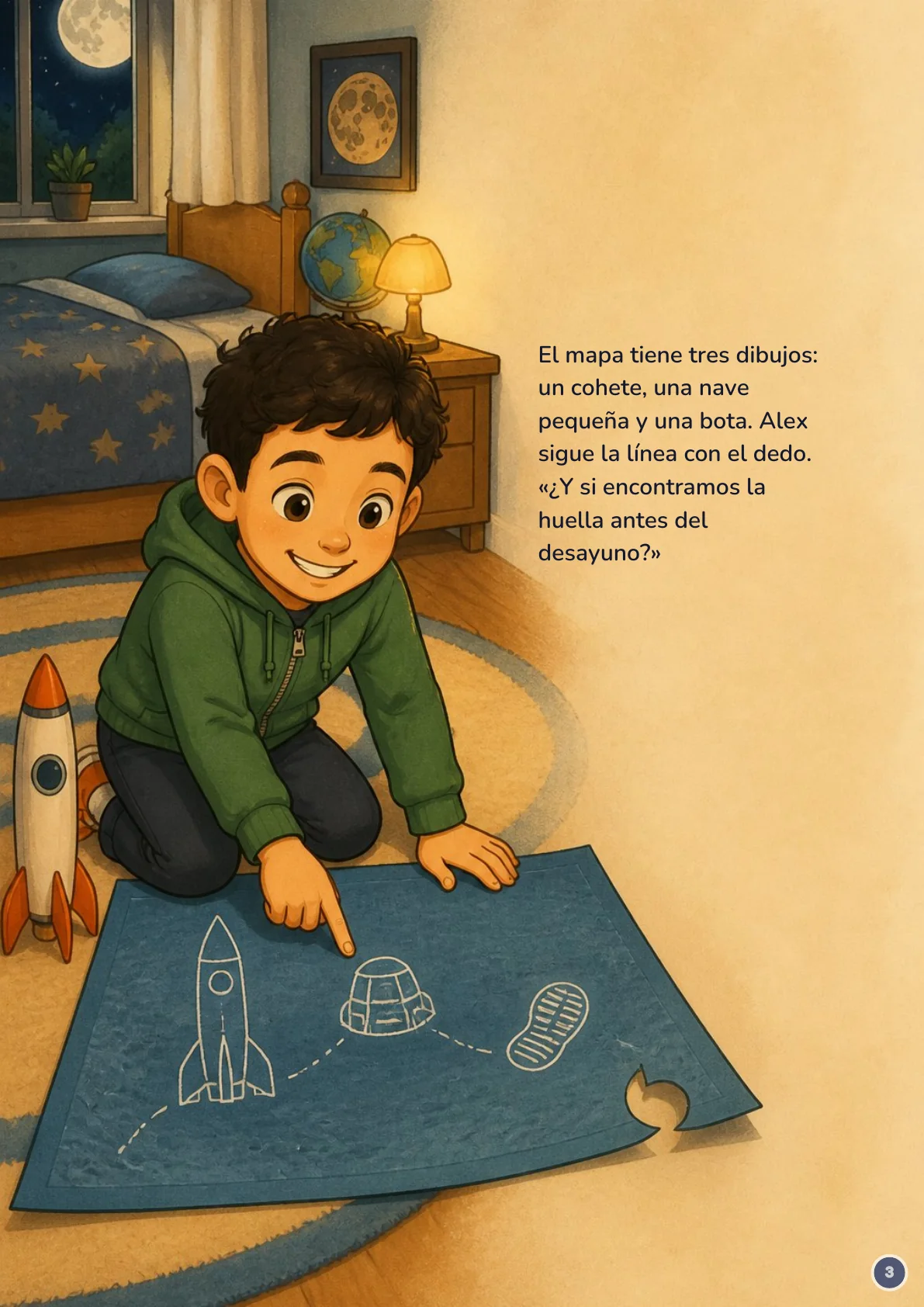
El mapa tiene tres dibujos: un cohete, una nave pequeña y una bota. Alex sigue la línea con el dedo. «¿Y si encontramos la huella antes del desayuno?»The rocket, spacecraft and boot give the search an order. Before turning the page, name them and wonder how they might lead to the footprint. On page 17, Alex brings the same three clues together again: you can return to this page and compare.
Alex’s question is whether they can find the footprint before breakfast. That ordinary deadline keeps the adventure close to home. A huge journey can happen in the imagination while breakfast is still waiting.
A question to share: What do you think the boot will tell us when we reach it?
Page 11: a footprint and an imaginary bakery
Excerpt from the Spanish story
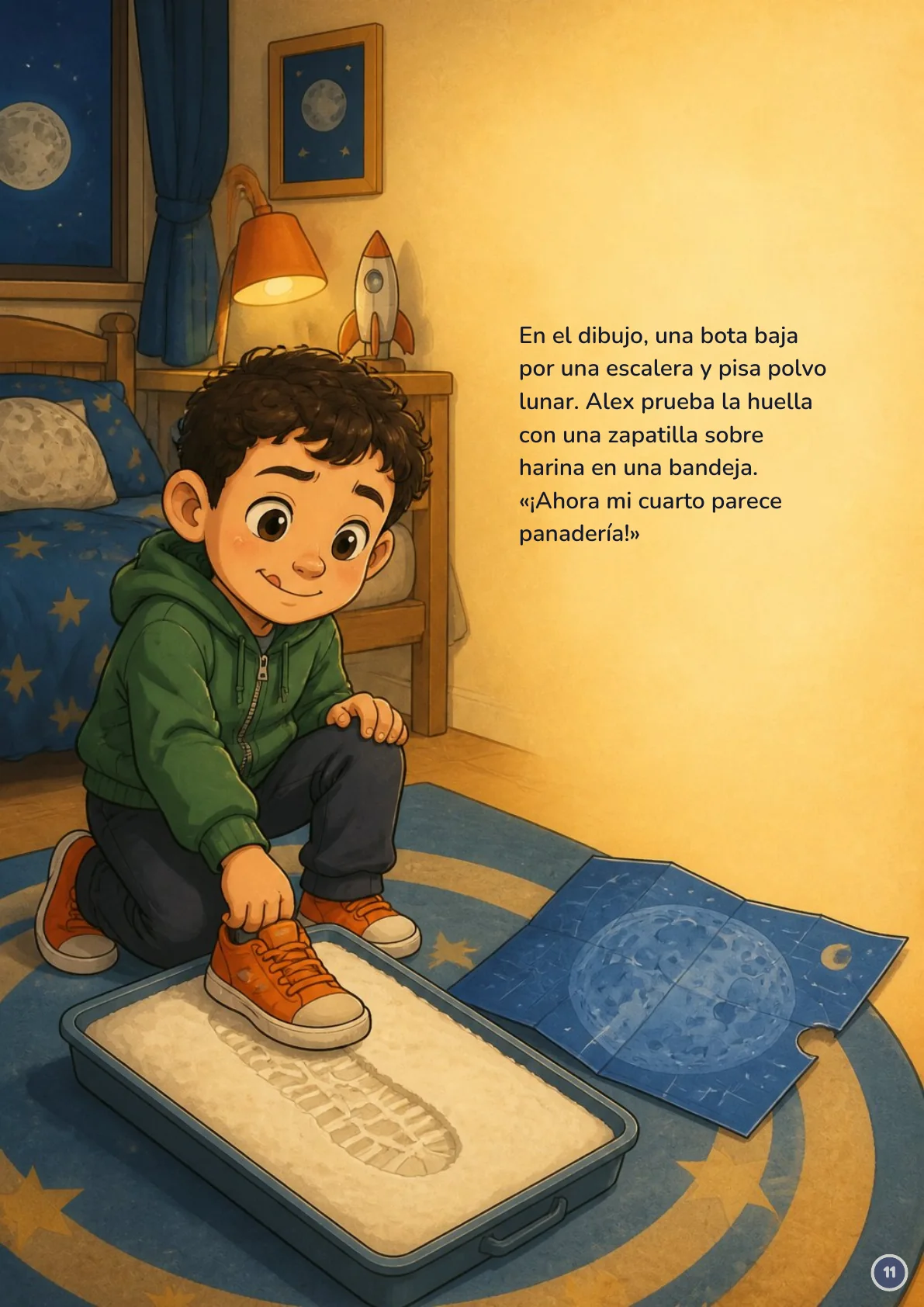
En el dibujo, una bota baja por una escalera y pisa polvo lunar. Alex prueba la huella con una zapatilla sobre harina en una bandeja. «¡Ahora mi cuarto parece panadería!»The scene connects a picture Alex sees with something Alex does in the bedroom. A shoe pressed into flour leads to the joke that the room now looks like a bakery. You can separate what belongs to the historical journey from what belongs to Alex’s game.
You do not need to recreate the scene to talk about it. Drawing a shoe sole and its mark is enough to imagine the traces different objects might leave. The story’s game does not demonstrate how dust or gravity behave on the Moon.
A question to share: Which part happens in the Moon picture, and which part happens in Alex’s room?
Page 18: the sock returns at the end
Excerpt from the Spanish story
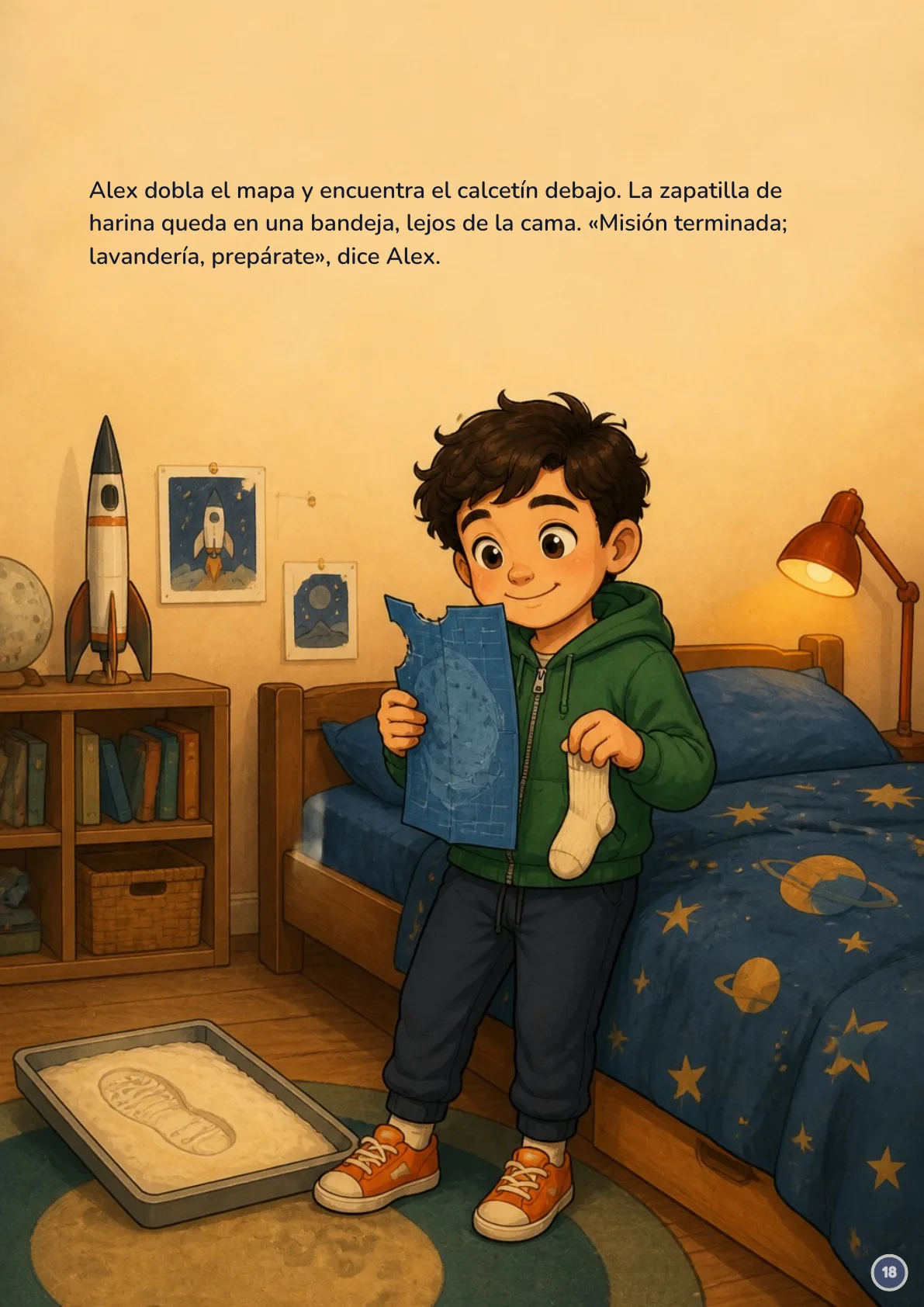
Alex dobla el mapa y encuentra el calcetín debajo. La zapatilla de harina queda en una bandeja, lejos de la cama. «Misión terminada; lavandería, prepárate», dice Alex.On page 2, Alex was holding a sock. Now it appears underneath the map, once the question about the footprint has been answered. That small return connects the opening and ending without starting another adventure.
If nobody remembers the sock, return to the first scene and find it in the text. The final joke announces that the laundry should get ready. After talking about the Moon, the story comes back to the familiar task of picking up clothes.
A question to share: What object would you put at the beginning of your story to find again at the end?
Apollo 11: separate the real mission from the game
Alex’s dialogue, map and games are fictional. To put the historical names in context, these NASA references offer a way to continue the conversation:
Armstrong was the first person to step onto the Moon, followed by Aldrin. Collins was the command module pilot. In the story, Alex’s two small boxes help imagine that the spacecraft had parts with different jobs. NASA: the Apollo 11 crew
The timeline needs more detail than the story’s three buttons: Apollo 11 launched on 16 July 1969, entered lunar orbit on 19 July, landed on 20 July and returned to Earth on 24 July. If the story’s “three days” raises a question, distinguish reaching lunar orbit from landing. NASA: the Apollo 11 timeline
Look at a mission photograph alongside a story illustration: which objects can you recognise, and what changes when they become a drawing? The sample is a fictional story, not a technical reconstruction of the mission.
Afterwards: tell the search in three drawings
Use paper and pencils to make three panels. Your child can draw, dictate a sentence or point to what they want to include.
- A question: what is the character looking for? Alex searches for the first footprint; your version might start with a missing object at home.
- A clue: what does the character find, and what do they decide to do? Choose an object that changes the next step, as the map changes Alex’s route.
- A return: how does it end, and what appears again? Bring back a detail from the first drawing to close the story.
Read the three panels in order. You can change the ending or leave it for another day. Leave room for your child to invent a question and choose how much of the story to tell.
If you want to create your own digital story
Notice what caught your child’s interest: following clues, looking at spacecraft or laughing at everyday objects. That can guide your story’s theme and tone. This example uses 2D cartoon illustrations; a new creation will have its own text and pictures.
On the website, a 20-page digital story costs €3.99 as a one-off purchase and includes a web reader and PDF. A printed book and home delivery are not included. This is the web price; if you buy through an app, check the amount shown by that store.
Before sharing it with a child, review the name, text and connections between scenes and illustrations. Results can vary and may contain mistakes. Photo personalisation does not guarantee an exact likeness. If you use a child’s photo, review the privacy terms and make sure you have the necessary permission.
Read the guide to children’s photos and privacyStart with the complete example
Open all twenty pages, try reading on your own screen and decide whether this kind of story fits what you are looking for.
Open all 20 pages of Alex’s story in SpanishCreate our digital story